









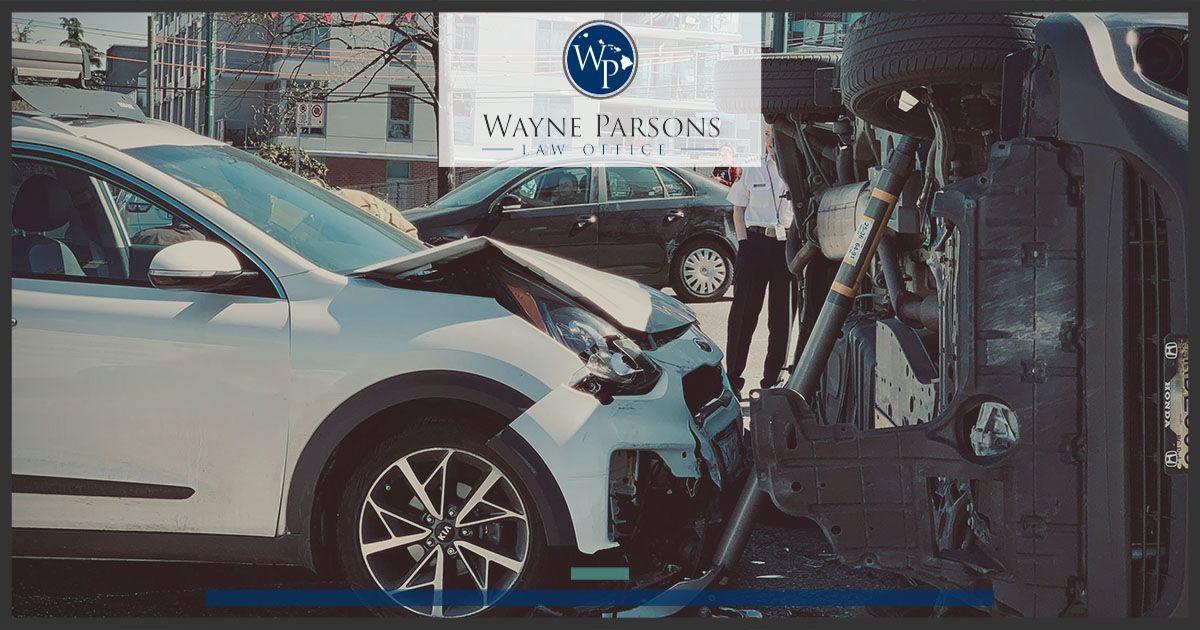
When several drivers contribute to the same Hawai‘i car accident, fault can be split between them, and those percentages can have a direct effect on how much compensation an injured person receives. On busy O‘ahu roads like the H1, H2, Kamehameha Highway, and major streets around Honolulu, one bad decision can set off a chain reaction with several vehicles in a matter of seconds.
In fact, a recent crash on O‘ahu shows how messy that can become.
In August 2026, an eight-vehicle collision blocked several westbound lanes of the H1 near the H1 and H2 split.
Hawaii News Now reported that two women were hospitalized, one in serious condition, while another person was evaluated at the scene. With that many vehicles involved, there may not be one obvious answer to the question, “Who caused the crash?”
Sometimes the better question in a motor vehicle crash is, “How much did each driver contribute?”
Hawai‘i Modified Comparative Negligence Law
Hawai‘i follows a modified comparative negligence system, which means you (the injured person) can still recover damages when you share some of the blame, as long as your negligence isn’t greater than the combined negligence of the parties you’re pursuing.
The basic idea is pretty straightforward.
- 10 percent fault can reduce your compensation by 10 percent
- 25 percent fault can reduce your compensation by 25 percent
- 50 percent fault can still allow your recovery in some cases
- More than 50 percent fault can block your recovery entirely
That last point matters a lot.
In a serious injury case, the difference between being found 45 percent at fault and 51 percent at fault can completely change the result.
How Hawai‘i Insurance Adjusters Assign Percentage of Fault
Insurance adjusters in Hawai‘i usually assign percentages of fault by first comparing each driver’s story with the physical evidence. Their opinion matters during the claims process, but it isn’t automatically the final word.
Adjusters may review:
- Police reports and eyewitness statements
- Vehicle damage
- Traffic camera and dashcam footage
- Lane positions
- Skid marks and other braking evidence
- Speed estimates
- Cell phone records
- Vehicle event data
Picture a four-car crash on the H 1.
The first driver brakes suddenly. The second follows too closely. The third is speeding. The fourth is distracted.
Several people may have contributed, but not necessarily by the same amount.
That’s why the sequence of events is so important.
Impact of Shared Fault on Your Financial Recovery
Shared fault reduces your recovery according to your percentage of responsibility. If your damages total $400,000 and you’re found 20 percent at fault, your potential recovery could drop to $320,000.
At 40 percent fault, the reduction becomes much larger. Those numbers add up fast when the claim involves serious injuries.
Damages may include medical bills, future treatment, lost wages, reduced earning ability, pain and physical limitations, and property damage. A dispute over just a few percentage points can represent tens of thousands of dollars.
That’s why insurance companies pay so much attention to fault.
The Role of Hawai‘i No-fault Insurance Benefits
Hawai‘i’s no-fault system can help you cover certain medical expenses before the insurance companies finish arguing about responsibility. Personal injury protection, commonly called PIP, can pay your qualifying medical and rehabilitation costs regardless of who caused the crash.
That can be especially helpful in a multi-vehicle collision.
Medical treatment can’t wait while several insurers spend weeks or months blaming each other. Still, no fault doesn’t mean fault never matters. Responsibility can still be important for vehicle damage and injury claims that go beyond basic PIP coverage.
Think of PIP as the first layer of coverage, not necessarily the final one.
Evidence You’ll Need to Prove Liability
Proving liability in a multi-vehicle crash usually means reconstructing the accident step by step and determining what each driver did immediately before impact. That’s difficult to do from memory alone.
Objective evidence often tells the clearer story.
Useful legal steps include:
- Taking photos of every vehicle. Damage patterns can help show where each vehicle impact occurred and which collision occurred first.
- Getting the police report. It may include witness names, road conditions, driver information, and initial observations.
- Looking for any videos. Dashcams, traffic cameras, businesses, and nearby vehicles may have recorded part or all of the crash.
- Talking to independent eyewitnesses. An observer from another lane may have seen something the drivers missed.
- Preserving electronic evidence. Vehicle data and phone records may help when speed, braking, or distraction is disputed.
- Reconstruct the sequence. Being pushed into another vehicle isn’t the same as independently causing that impact.
That distinction can completely change the fault analysis.
Wayne Parsons Law Office Advocates for Car Accident Victims
When multiple drivers share fault in a Hawai‘i car accident, the final outcome often depends on much more than which vehicle hit first. Each driver’s actions need to be evaluated separately, and those percentages can directly affect the amount of compensation available.
At Wayne Parsons Law Office, we understand how that can get complicated quickly, especially on Honolulu’s busiest roads. One driver may be speeding. Another may be following too closely. Someone else may react too late.
In a large chain-reaction crash, several mistakes can occur almost simultaneously.
Carefully sorting out those few seconds can make all the difference in who pays, how much they pay, and whether you receive fair compensation.
Contact us today and let’s start sorting it out together.